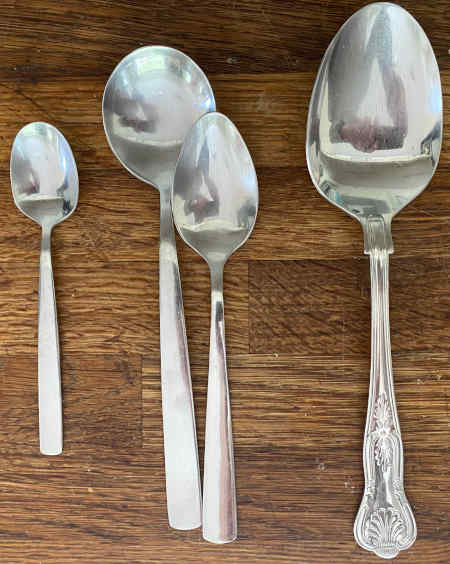
Often when following recipes there will be ingredients specified as spoon or cup sizes. These measurements are inherently a little inaccurate because different ingredients can weigh differently or be more coarse/fine ground. However, the best we can do is to be at least as accurate as we can.
You can use the NutriCherry App for most conversions and it also has a more complete set of rules of thumb on the page too.
Let's start with a few definitions around what each of these spoons are:
Teaspoon
See the leftmost spoon in the above image. The smallest of the three spoons in the kitchen, this is normally the spoon you'd use to when making tea and adding sugar.
A teaspoon is approximately 5 ml.
Desert/soup spoon
See the middle spoons in the above image. This is the middle size spoon normally used for deserts and soups, in some cultures it also replaces the knife during certain main courses. Importantly, this is not a tablespoon, it is in fact about half the volume. It is seldom called for in recipe measurements.
Tablespoon
See the largest, rightmost spoon in the above image. The largest size of spoon normally used for decanting items (such as veg) out of serving bowls, and measuring out volumes for recipes.
As a rule of thumb a tablespoon is about 15 ml, a tablespoon of olive/sunflower oil is around 20 grams, and water about 15 grams.
Flour/water cup measurements
In some recipes a cup of flour or water will be called for. The cup is a standard measurement based on a regular sized kitchen cup.
As a rule of thumb the cup size used in recipes is 237 ml, water will weigh approximately the same I.E. 237g.
In most cases, a cup of flour comes in at around 120 grams. However, it can vary a lot and personally, if the flour in the recipe is critical to success, I would weight it.
These may be of interest
- Similar - Baking and Cooking with oils and salts
- Similar - Tools needed for bread making
- Similar - Bread Maker 101: How they work, how to use one
- Similar - Make your own italian herb mix from scratch
- Similar - Making bread using yeast
